
Data Science Weekly - Issue 644
Curated news, articles and jobs related to Data Science, AI, & Machine Learning

Issue #644
March 26, 2026
Hello!
Once a week, we write this email to share the links we thought were worth sharing in the Data Science, ML, AI, Data Visualization, and ML/Data Engineering worlds.
This Week in Data Science Weekly (Paid)
Each week, paid subscribers get 3 additional deep dives to help you:
Understand core statistics
Build with modern AI tools
Become more valuable at your job
Statistics
AI Agents
Starting this week: A third weekly post: Career Accelerator (Fridays)
If you’ve been reading for a while, this is where things go deeper.
👉 Get all 3 posts each week → Upgrade for $10/month
And now…let’s dive into some interesting links from this week.
Editor's Picks
Bayesian statistics for confused data scientists
It’s the third time I’ve fallen into the Bayesian rabbit hole. It always goes like this: I find some cool article about it, it feels like magic, whoever is writing about it is probably a little smug about how much cooler than frequentism it is (and I don’t blame them), and yet I still leave confused about what exactly is happening. This post is a cathartic attempt to force myself into making sense out of everything I’ve read so far, and hopefully it will also be useful to the legions out there who surely feel the same way as I do…
If DSPy is So Great, Why Isn’t Anyone Using It?
DSPy’s problem isn’t that it’s wrong. It’s that it’s hard. The abstractions are unfamiliar and force you to think a little bit differently. And what you want right now is not to think differently; you just want the pain to go away…But I keep watching the same thing happen: people end up implementing a worse version of Dspy. I like to jokingly say there’s a Khattab’s Law now (based off of Greenspun’s Law about Common Lisp):Any sufficiently complicated AI system contains an ad hoc, informally-specified, bug-ridden implementation of half of DSPy.
You’re going to build these patterns anyway. You’ll just do it worse, after a lot of time, and through a lot of pain…
Data Manipulation in Clojure Compared to R and Python
The format is inspired by this great blog post I read a while ago comparing R and Polars side by side (where “R” here refers to the tidyverse, an opinionated collection of R libraries for data science, and realistically mostly dplyr specifically). I’m adding Pandas because it’s among the most popular libraries for dataset manipulation, and, of course, Clojure, specifically tablecloth, the primary data manipulation library in our ecosystem. I’ll use the same dataset as the original blog post, the Palmer Penguin dataset…
What’s on your mind
This Week’s Poll:
.
Last Week’s Poll:
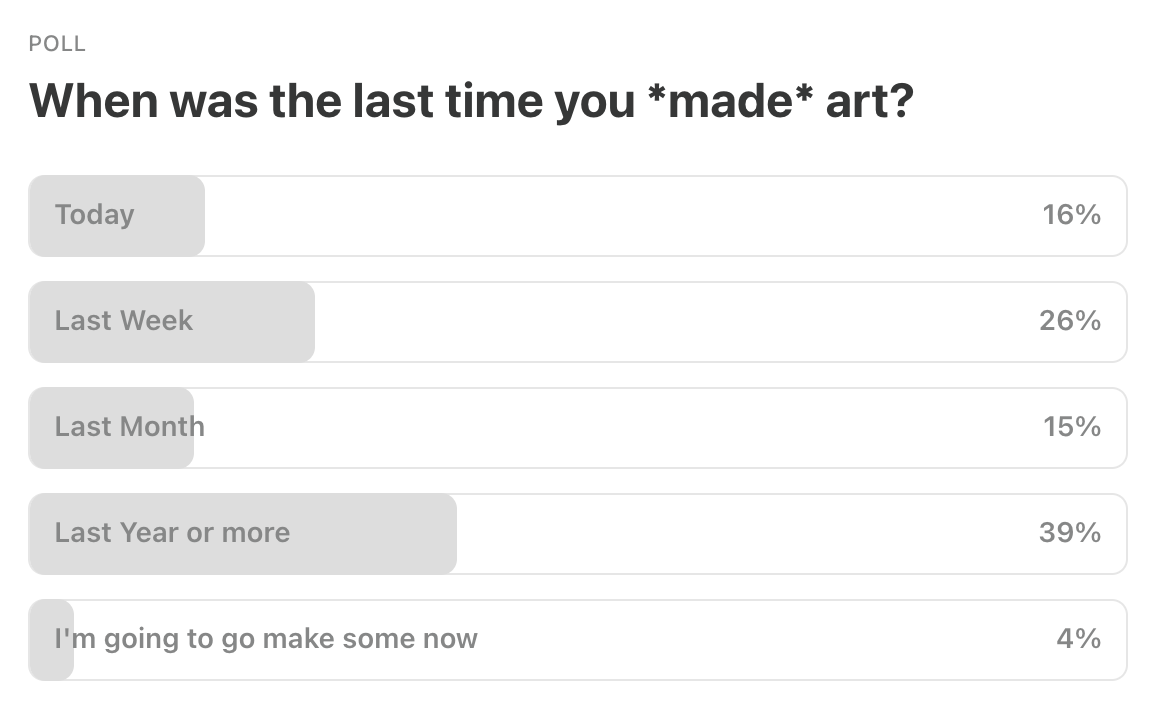
.
Data Science Articles & Videos
The absolute beginners guide to databasemaxxing
I get a lot of emails from people asking me how they can begin to learn the vast world of databases, and whether they are far enough along on their programming journey to bother trying to start to learn this sub-genre of CS. This post is meant to be my authoritative answer to those questions.…Has the industry effectively killed off academic machine learning research in 2026? [Reddit]
This wasn’t always the case, but now almost any research topic in machine learning that you can imagine is now being done MUCH BETTER in industry due to a glut of compute…Also, notice that researchers/academic faculties are overwhelmingly moving to industry or becoming dual-affiliated or even creating their own pet startups. I think ML academics are in a real tight spot at the moment. Thoughts?…
Against Time Series Foundation Models Or: My Experience in Modern Forecasting
Time-series foundational models (TSFMs) are currently engaged in a knife fight to prove their worth against statistical models that have been around for half a century…My prediction is that TSFMs will have some limited uses, but the future is not going to be larger and larger time-series foundation models. The future is going to be general agentic models doing search over specific forecasting problems, and then fitting something closer to a structural time-series model…What is entropy, really?
I first saw the term “entropy” in a chemistry course while studying thermodynamics. During my graduate studies I encountered the term in many different areas of mathematics. Can anyone explain why this term is used and what it means. What I am looking for is a few examples where the term “entropy” is used to describe some mathematical object/quantity and its meaning there…Jacobi Fields in Machine Learning
The goal of this blog post is to provide an intuitive definition of Jacobi fields, a concept from differential geometry, and explain their usefulness for machine learning on curved manifolds. In a nutshell, they are particularly relevant if you are trying to determine a relation between the difference of two vectors and in a tangent space to a manifold (or a power of it), and the geodesic distance between end-points of geodesics with those vectors as initial velocities…So where are all the AI apps?
Fans of vibecoding and agentic tools say they are 2x as productive, 10x as productive – maybe 100x as productive!…So, skeptics reasonably ask, where are all the apps? If AI users are becoming (let’s be conservative) merely 2x more productive, then where do we look to see 2x more software being produced?…We’ll look at PyPI, the central repository for Python packages. It’s large, public, and consistently measured, so we should expect to see some AI effect there…Intuitions for Transformer Circuits: A mental model for addressing the residual stream
This post is a brain dump of what I’ve learned so far after reading A Mathematical Framework for Transformer Circuits (herein: “Framework”) and working through the Intro to Mech Interp section on ARENA. My goal is to describe my current intuition for the paper, especially parts I was confused about so that perhaps my take can help others gain clarity on these areas as well…An Unsolicited Guide to Being A Researcher
There is no one valid goal for a student to have. There are many that are possible. What’s important is knowing what your goals are…Introduction to Programming for the Brain and Cognitive Sciences
Welcome! This is the online textbook for the UIUC course BCOG 200/PSYC 496: Introduction to Programming for Brain and Cognitive Science…
Cheng Chi: Robotics Beyond Algorithms [ETHZ Robot Learning 2026]
In this guest lecture for the ETH Zurich course “Robot Learning: From Fundamentals to Foundation Models” (Spring 2026), hosted and led by Oier Mees, Cheng Chi (Co-Founder & CTO of Sunday Robotic) talks about how practical “tips and tricks” of building real-world robotic systems, the kind of hard-earned lessons and insights that are difficult to learn in academia…In this paper, we introduce a simple approach to handwriting generation that allows us to generate high-quality cursive from scratch. We do this by using a custom tokenizer to map pen stroke data to token sequences and then, without any special architectural changes, training a plain GPT model. This figure gives a visual illustration of how our custom tokenizer works:…
Does TV Show Quality Matter on Streaming? A Statistical Analysis
Today, we’ll investigate the relationship between artistic merit and television viewership, examining which series attract audiences on Netflix, Hulu, HBO Max, and beyond…JAX-LM: Language Modelling and Distributed Training in JAX
In this blog, we’ll implement a language model from scratch in JAX, then scale it up with distributed training across multiple GPUs/TPUs…
.
Last Week's Newsletter's 3 Most Clicked Links
.
* Based on unique clicks.
** Please take a look at last week's issue #643 here.
Cutting Room Floor
BFChess: A Chess Engine in Brainfuck, Built by a Coding Agent
Representations in the hippocampal-entorhinal system emerge from learning sensory predictions
TurboQuant: Redefining AI efficiency with extreme compression
Robotics Needs Fewer Roboticists per capita. A case for deploying intelligent manipulators today
.
Whenever you're ready, 3 ways we can help:
Go deeper each week (paid subscription)
Get 3 additional posts per week designed to help you:Statistics → understand the math behind ML
AI Agents → build with modern AI tools
Career → become more valuable at your job
Looking to get a job?
A practical guide to landing your first (or next) data science role, based on thousands of reader questions.
👉 Check out our “Get A Data Science Job” CoursePromote your company to ~68,000 subscribers
Sponsor this newsletter and reach a highly engaged data science audience (30–35% open rate).
👉 Reply to this email to learn more
Thank you for joining us this week! :)
Stay Data Science-y!
All our best,
Hannah & Sebastian
Another fantastic issue! The curated mix of data science, ML, and AI articles is always spot-on. This newsletter has become one of my go-to weekly reads for staying current in the field. Keep up the great work!