
Data Science Weekly - Issue 648
Curated news, articles and jobs related to Data Science, AI, & Machine Learning

Issue #648
April 23, 2026
Hello!
Once a week, we write this email to share the links we thought were worth sharing in the Data Science, ML, AI, Data Visualization, and ML/Data Engineering worlds.
Sponsor Message
Online Data Science Programs from Drexel University

Find your algorithm for success with an online data science degree from Drexel University. Gain essential skills in tool creation and development, data and text mining, trend identification, and data manipulation and summarization by using leading industry technology to apply to your career. Learn more.
.
* Want to sponsor the newsletter? Email us for details --> team@datascienceweekly.org
And now…let’s dive into some interesting links from this week.
Editor's Picks
Your Name in Landsat 🛰️
Type your name and see it spelled out in stunning Landsat satellite imagery. Explore Earth from space, letter by letter, with NASA and USGS Landsat images…
Trajectory shapes
Why are we managing our coding agents based on vibes instead of their actual work habits?…I analyzed the latest SWE-Bench Pro trajectories I could find: runs from October 2025 for Sonnet 4.5 and GPT-5, 730 task trajectories per model. I deterministically classified each step into activities like understand, edit, verify, and cleanup using only tool calls, literal command/filename matches, and regex heuristics, and then computed their share over time. This “trajectory shape” chart I got as a result is very interesting!…If I were to condense the above to “vibes”, I might say “Claude starts editing early and figures it out in the loop. GPT reads first, then goes for the one-shot.” That is also close to what people on my timeline were saying when these runs were current. For example…Build yourself flowers
This is an edited transcript of the keynote I gave at the Applied Machine Learning Conference in Charlottesville, VA in April 2026…I’m Vicki, and I build machine learning systems…I debated for a long time how to introduce myself. Am I a data scientist? Am I still a machine learning engineer? Am I an AI engineer now? I’m not really sure. I think, like a lot of people over the past six months in the industry, I’ve been having existential angst. So, I’ll go with “I build machine learning systems.”...The larger question behind my existential angst is, what is the state of machine learning engineering as an industry today? That is - is it still worth doing machine learning engineering?…And the second question that came to me was, not only is it still worth doing ML, but, in an era where we’re having LLMs generate a lot of code, when the most important thing is for us to ship quickly, to get to a prototype quickly, is it still worth doing machine learning well?…the same question of, in a world where it’s easy and fast to write code, why is technical excellence still important?…
What’s on your mind
This Week’s Poll:
.
Last Week’s Poll:
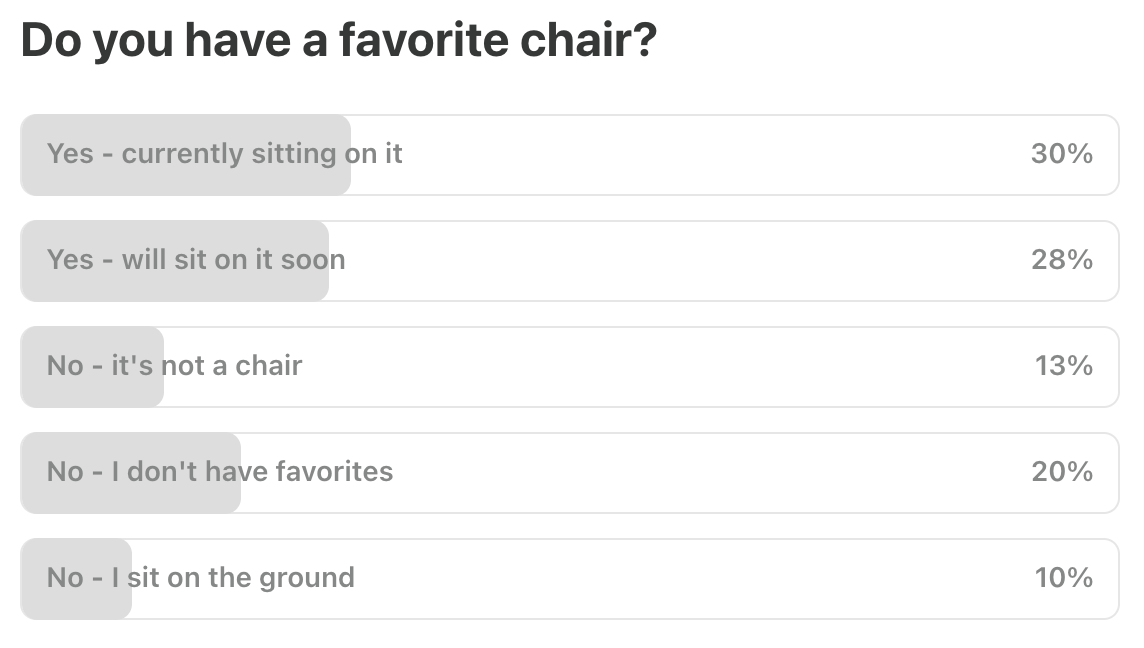
.
Data Science Articles & Videos
Columnar Storage is Normalization
Something I didn’t understand for a while is that the process of turning row-oriented data into column-oriented data isn’t a totally bespoke, foreign concept in the realm of databases. It’s still of the relational abstraction. Or can be. As an example, say we have this data…Anyone else paranoid using AI for analysis? [Reddit]
With the LLM in the loop, I touch the data less, and I catch less.
Do you also feel one step removed from the data compared to before these tools existed?
What are you doing to safeguard and double-check AI-assisted analysis?
Has AI-assisted analysis ever caused you to ship a wrong number to a stakeholder? What happened?…
A Tutorial on Thompson Sampling
Thompson sampling is an algorithm for online decision problems where actions are taken sequentially in a manner that must balance between exploiting what is known to maximize immediate performance and investing to accumulate new information that may improve future performance. The algorithm addresses a broad range of problems in a computationally efficient manner and is therefore enjoying wide use. This tutorial covers the algorithm and its application, illustrating concepts through a range of examples, including Bernoulli bandit problems, shortest path problems, product recommendation, assortment, active learning with neural networks, and reinforcement learning in Markov decision processes…On Rejection and Competition
This blog post will cover two topics. First, how to deal with the emotional feeling of being rejected for a role. Second, a re-framing and discussion of how to feel about the person who did get the role…No raw data, no science: another possible source of the reproducibility crisis
As an Editor-in-Chief of Molecular Brain, I have handled 180 manuscripts since early 2017 and have made 41 editorial decisions categorized as “Revise before review,” requesting that the authors provide raw data. Surprisingly, among those 41 manuscripts, 21 were withdrawn without providing raw data, indicating that requiring raw data drove away more than half of the manuscripts…Learning to Maximize Rewards via Reaching Goals
Goal-conditioned reinforcement learning learns to reach goals instead of optimizing hand-crafted rewards. Despite its popularity, the community often categorizes goal-conditioned reinforcement learning as a special case of reinforcement learning. In this post, we aim to build a direct conversion from any reward-maximization reinforcement learning problem to a goal-conditioned reinforcement learning problem, and to draw connections with the stochastic shortest path framework. Our conversion provides a new perspective on the reinforcement learning problem: maximizing rewards is equivalent to reaching some goals….Marathon Man: how to pace a marathon
Let’s take a look at a big dataset of marathon times – we’ll use the New York City Marathon from 2025 – to see if we can understand how to pace a marathon. There’s an available dataset of chip times (meaning we don’t have to worry about dodgy GPS data) and the course has similar first and second half profiles, allowing us to use these times to understand negative/even/positive splitting. Let’s dive in….Using R to Teach R: Lessons for Software Development
If you have read our blogs previously then you will be aware that Jumping Rivers is a consultancy and training provider in all things data science. But did you know that we offer over 50 different courses spanning R, Python, Git, SQL and more?…In this blog we will provide a glimpse into our internal process and share how we have streamlined the task of maintaining so many courses. Along the way we will share some good practices applicable to any big coding project, including packaging of source code and automated CI/CD…Machine Learning Frameworks in R
R’s ecosystem offers a rich selection of machine learning frameworks, each with distinct design philosophies and strengths. This post is a side-by-side comparison of five ML frameworks in R that provide unified interfaces over multiple algorithms, with runnable code examples on the same dataset so you can compare APIs directly. The focus is on packages that let you swap algorithms without rewriting your code…
Creating a future-proof enterprise agentic platform architecture
A difficult (though familiar) set of questions:How do we capture short-term impact without creating waste or long-term technical debt?
What architecture best supports a mesh of AI agents and traditional, deterministic capabilities across workflows?
Which services and capabilities do we need to build now to support what we’ll need in two years?
Is it even worth building today when a viable market solution may exist in a couple of years?
How do we balance speed with control, and set standards for security, traceability, and observability in an agentic system that’s non-deterministic?
There are no universal answers to these questions yet. But through our work with three financial institutions deploying agentic systems at scale, we have developed a set of practical approaches that define what matters most, where teams risk over-investment, and what tends to be harder than expected…
The Broader Landscape of Robustness in Algorithmic Statistics
The last decade has seen a number of advances in computationally efficient algorithms for statistical methods subject to robustness constraints. An estimator may be robust in a number of different ways: to contamination of the dataset, to heavy-tailed data, or in the sense that it preserves privacy of the dataset. We survey recent results in these areas with a focus on the problem of mean estimation, drawing technical and conceptual connections between the various forms of robustness, showing that the same underlying algorithmic ideas lead to computationally efficient estimators in all these settings…
CEO cancels BI tooling, replaces it with AI, breaks everything [Reddit]
This happen with a client a coupla months ago. they had their dashboards in metabase, he cancelled > handed the team claude > “dashboards are a waste and just go and ask ai”. as you can guess he then called me saying he thinks he broke sth….heard almost the same story from another data consultant last week. different company, same swap, same outcome is this becoming a pattern or if we just both got unlucky clients?…Six Characters
What the PNR locator on your boarding pass actually contains, and why the fare calculation line on your e-ticket is written in a currency that does not exist…
.
Last Week's Newsletter's 3 Most Clicked Links
.
* Based on unique clicks.
** Please take a look at last week's issue #647 here.
Cutting Room Floor
The Living Lattice - Explorables of the intelligence theorem.
Agent Skills for Google products and technologies, including Google Cloud.
.
Whenever you're ready, 3 ways we can help:
Go deeper each week (paid subscription)
Get 3 additional posts per week designed to help you:Statistics → understand the math behind ML
AI Agents → build with modern AI tools
Career → become more valuable at your job
Looking to get a job?
A practical guide to landing your first (or next) data science role, based on thousands of reader questions.
👉 Check out our “Get A Data Science Job” CoursePromote your organization/project/event to ~68,500 subscribers
Sponsor this newsletter and reach a highly engaged data science audience (30–35% open rate).
👉 Reply to this email to learn more
Thank you for joining us this week! :)
Stay Data Science-y!
All our best,
Hannah & Sebastian