
Data Science Weekly - Issue 661
Curated news, articles and jobs related to Data Science, AI, & Machine Learning

Issue #661
July 23, 2026
Hello!
Once a week, we write this email to share the links we thought were worth sharing in the Data Science, ML, AI, Data Visualization, and ML/Data Engineering worlds.
And now…let’s dive into some interesting links from this week.
Editor's Picks
Why non-invasive glucose monitoring is hard
Continuous glucose monitoring on Apple Watch and other smartwatches has been “5-7 years away” for roughly a decade…I trained one of the first deep neural networks to detect signs of diabetes with consumer health sensors. This post will explain what makes glucose sensing so hard, what hardware and machine learning techniques have been tried, and try to describe which research techniques are actually feasible on a consumer device like an Apple Watch, Pixel, Oura, or Samsung Watch. Let’s start by explaining why an already-launched feature, blood oxygen sensing, actually works in practice using relatively cheap optical sensors…
Navigating Challenges in Spatial Machine Learning
Spatial machine learning has become a standard tool for producing environmental and geographic prediction maps. It is now relatively (technically) easy to combine field observations with remote sensing, climate, terrain, or other predictor layers and fit a strong machine learning model. The harder question is whether the resulting map is reliable, transferable, and reproducible…Spatial dependence, clustered and biased sampling, heterogeneous landscapes, and domain transfer all affect how models should be evaluated and interpreted. A model can appear accurate under a standard validation approach and still be unreliable where predictions are needed…Exploring Gymflation with AI
You might be familiar with super hero inflation? Over time, super hero physiques on screen have become increasingly exaggerated. Batman’s progression from Adam West to Ben Affleck is a great example of this…Gymflation is much the same idea. As gym culture has skyrocketed, it seems like so too have people’s feats of strength - as recorded on social media. Going on YouTube or Instagram one gets the feeling that a 200kg deadlift is really rather average nowadays. But is it really true? Or are we just feeling the effects of the Algorithm, pushing extreme examples in our blue-lit faces? What follows is a little project to find out…
.
What’s on your mind
This Week’s Poll:
.
Last Week’s Poll:
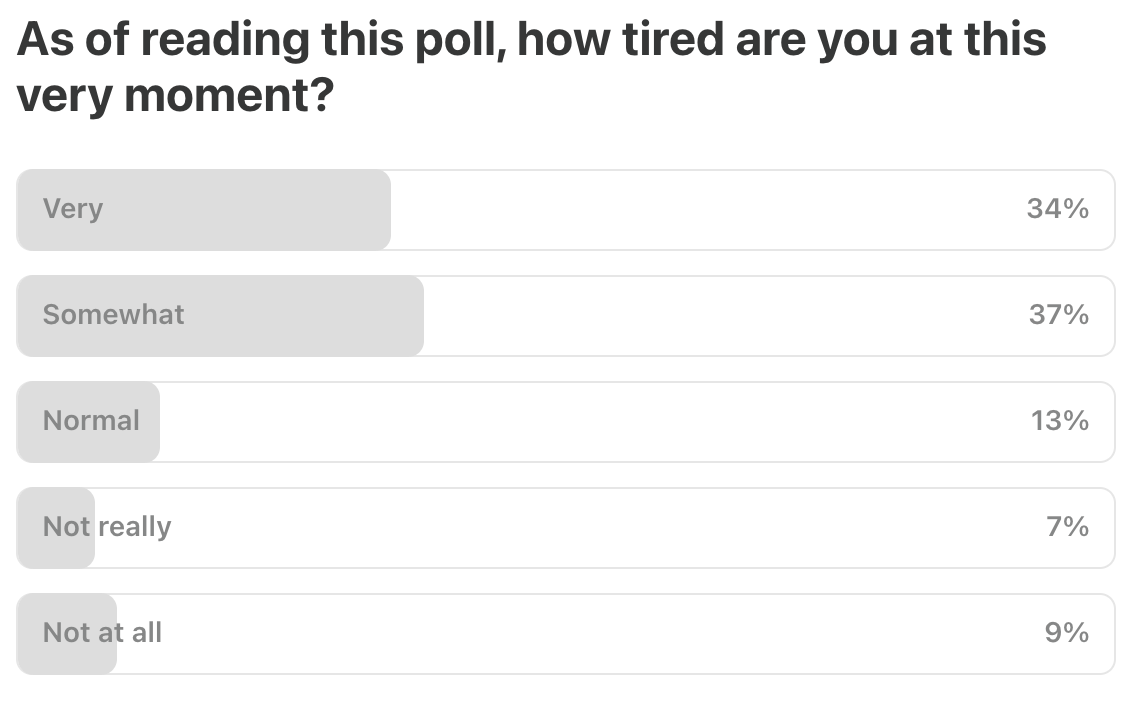
.
Data Science Articles & Videos
Easy A’s, Less Pay: The Long-Term Effects of Grade Inflation
Average grades continue to rise in the United States, raising the question of how grade inflation impacts students. We provide comprehensive evidence on how teacher grading practices affect students' long-run success. Using administrative high school data from Los Angeles and from Maryland that is linked to postsecondary and earnings records, we develop and validate two teacher-level measures of grade inflation: one measuring average grade inflation and another measuring a teacher's propensity to give a passing grade…The cumulative impact is economically significant: a teacher with one standard deviation higher average grade inflation reduces the present discounted value of lifetime earnings of their students by $213,872 per year…What Do Today’s Data Science Graduates Commonly Lack? [Reddit]
I often read comments from hiring managers and interviewers saying they’re disappointed with recent data science graduates. I’m curious, what do you think these graduates are lacking? If someone wants to become a data scientist, what skills should they focus on? Strong software engineering skills? Math and statistics? Something else?…
How Hollywood Stopped Making Movies in Hollywood
The economics behind where movies are filmed, why Hollywood left Los Angeles, and whether audiences can tell the difference…The Unreasonable Difficulty of Time Series Forecasting
I’ve been thinking recently about what makes time series forecasting problems so difficult compared to other sequence learning tasks or IID Machine Learning problems…for many ML problems, we don’t have full information about the casual factors either yet are able to do something reasonable, or at least better than a random walk. Hence, this post investigates the nature of the forecasting problem and what makes it so much more difficult than classical machine learning…Holding the LLM Stack in Your Head
A dependency-ordered walk through the modern LLM stack, from the linear algebra under a single attention head, through training and inference, out to agent protocols shipping in 2026. Ten arcs, eighty-odd posts. The goal isn't rigor, it's intuition that survives contact with real systems…
How to Bake a [Golf Shot] Dispersion Pattern from Scratch
I’ve built a realistic golf shot dispersion simulator and I’ve shared it for anyone to use…I wanted to write about variance in golf here, but when I was reviewing my theoretical, idealized dispersion patterns, I realized it was effectively pointless to start discussing variance in golf without generating realistic dispersion patterns. These golf shot dispersion patterns represent the inherent variance in the game, so we need the model to reflect them before looking at birdies and blow-ups…Colorblind: Checking figure accessibility for colour blind people
When preparing images for publication, it is good practice to check how accessible they are for colour blind people. Using a simple bit of code, it is possible to check an image – or a whole figure – in ImageJ for accessibility. For example, Figure 1 from our recent paper. Originally looked like this:..Understanding the AI economy
Google’s ATLAS is an expansive look at how people are using AI at work and in day-to-day life…Google is launching the first iteration of the AI & Economy ATLAS (Activity, Task, Landscape, and Adoption Study), an ongoing, large-scale, de-identified study of how people are using Google’s AI products and tools. ATLAS’s first dataset (v1.0) is built from 15 million aggregated and de-identified human-AI interactions across the Gemini App, AI Mode, and the Gemini API, which together are used by more than 1 billion people monthly. ATLAS v1.0 insights span more than 150 countries, 140 languages, 800 occupations, and 4,000 tasks; ATLAS is the most comprehensive look to date at how real people are using AI at scale…Our findings suggest that the spatiotemporal pattern from visual and proprioceptive information obtained through the precisely controlled hand movements when using a pen, contribute extensively to the brain’s connectivity patterns that promote learning…
Guide to data tools landscape for developers
Found yourself on a data project and have no idea what they all are talking about? Feel excluded from all the fun discussions in the office kitchen? If only there were a humongous guide going over all the concepts and buzzwords.….In this article, we will briefly go over the data lifecycle: where data comes from, how it’s handled, how it’s stored, and how it’s displayed. You will understand to which stage each particular tool belongs and which tasks it solves for people working with data. We won’t go into details about setting up each tool or comparing tools inside the same class in-depth. Trust me, the article will be pretty lengthy as is, even without going into any of those details…Scouting Uncertainty: adding value to data scouting results
I have been looking at spreadsheets for football scouting for over a decade, and every now and then, my perception completely changes…Lately, I’ve been creating more and more on a meta level, mostly in data engineering. In that light, I wanted to share something I have introduced in my day-to-day data scouting when working with aggregated data: scouting uncertainty. The idea is to add an uncertainty score to the scouting score to add a level of trust towards the data. If the data is trustworthy and uncertainty is low, the quality of data scouting for that specific player will be higher…
AI as an ETL and Report Builder? I’m tired. [Reddit]
We have been developing a Data Platform (IaC, CI/CD, orchestration, data quality, governance, the works). Everything is already set-up except for the business logic. Quite understandable since we built everything from FOSS about 2 months ago and I’m the only data platform engineer/data engineer in the company. They aren’t also keen on spending money on managed solutions. Now, a director is pushing to scrap our project in favor of an AI as an ETL solution. Basically, use skills and AI to generate reports from source systems and have AI use python, pandas and SQL to generate reports. This AI as an ETL couldn’t get out of the demo phase because of data quality issues….Reading ‘Radical Uncertainty’
I recently read John Kay and Mervyn King’s book Radical Uncertainty as part of an economics book club and I thought I would share some thoughts on the book here…Radical Uncertainty is about statistics, and especially about the problems with assuming that we can make probabilistic calculations while neglecting the possibility of things which we haven’t even contemplated happening. I was pretty fascinated by the first half of the book, but it does become quite long-winded in the second half, and repeats many of its points over and over again. The book makes a lot of good points, but I would also like to point out some mistakes which it makes when talking about statistical modelling…
.
Last Week's Newsletter's 3 Most Clicked Links
.
* Based on unique clicks.
** You can find last week's issue #660 here.
Cutting Room Floor
.
Thank you for joining us this week! :)
Stay Data Science-y!
All our best,
Hannah & Sebastian