
Data Science Weekly - Issue 662
Curated news, articles and jobs related to Data Science, AI, & Machine Learning

Issue #662
July 23, 2026
Hello!
Once a week, we write this email to share the links we thought were worth sharing in the Data Science, ML, AI, Data Visualization, and ML/Data Engineering worlds.
And now…let’s dive into some interesting links from this week.
Editor's Picks
How to make a mesh dance in real time to music
Audio transforms into a frequency space, where filtering becomes easy. The nice surprise is that meshes have a frequency space too…Take a drum head. Hit it and it doesn’t wobble arbitrarily; it rings in a discrete set of standing waves whose shapes are determined entirely by the drum’s geometry. Mark Kac asked in 1966 whether you could run that backwards: can one hear the shape of a drum?…On a triangle mesh those standing waves are the eigenvectors of the discrete Laplacian, its manifold harmonics. Low eigenvalues are slow global wobbles, high eigenvalues fine ripples: the same low-to-high ordering an FFT gives you, over a surface instead of over time…With this you can let the song drive the shape and get Kac’s question the other way. instead of hearing a shape, you see a sound…
Random Selection and Democracy in Athens and Asimov
Let’s look at some aspects of random selection as it relates to democracy through these examples. This post contains discussion questions and activities that could be used for a high school or undergraduate class discussion about the “fairness” of simple random, stratified, and systematic sampling — and of nonrandom selection methods. Learning objectives include deepening understanding of these sampling methods, distinguishing between proportional and disproportional allocation, calculating sampling weights for a stratified sample, and relating advantages and disadvantages of methods for political candidate selection to statistical principles of randomization. The footnotes contain some questions for an advanced undergraduate or graduate-level sampling class…London’s most equidistant pub
London’s most equidistant pub is The Greene Man at 383 Euston Road, on the corner of Great Portland Street. Starting from where each of the 33 boroughs’ residents actually live, and arriving by 7pm on an ordinary September Thursday by public transport, journeys to it span 47 minutes between the nearest borough and the furthest, and no borough needs more than 70. No pub in London does better on both measures….The bigger finding is what nobody manages: not one of London’s 3,170 pubs is within an hour of all 33 boroughs….
.
What’s on your mind
This Week’s Poll:
.
Last Week’s Poll:
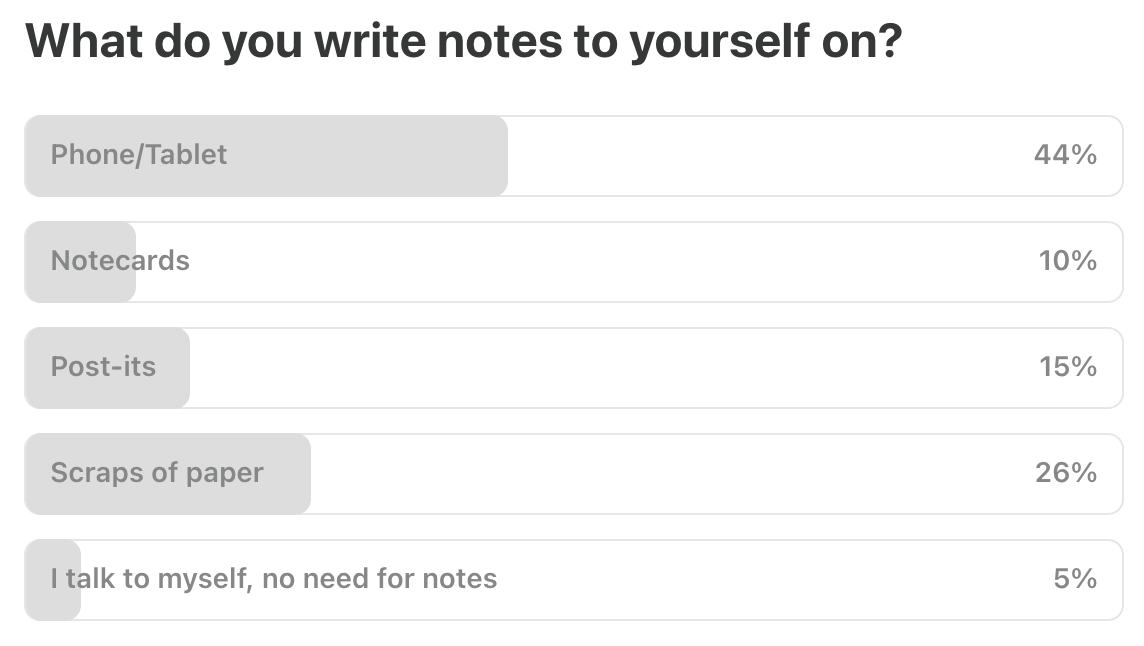
.
Data Science Articles & Videos
You Could Have Come Up With Kimi Delta Attention
In this post we are going to walk through the DeltaNet family of linear attention variants, two of which are used by the latest Qwen and Kimi model families, and show how you might have arrived at the same equations by asserting simple things about your hidden state. That is the route we will take: softmax attention → linear attention → DeltaNet → Gated DeltaNet → KDA Only after deriving KDA will we turn to the recurrent and chunkwise Triton programs that execute it…had a client once where the ops manager could just... answer things. revenue by region, churn this month, whatever. no ticket, no slack message to the data team, just opened metabase and pulled it herself i’ve been thinking about that a lot lately because most places i go into are nothing like that. analyst gets pinged for stuff that really shouldn’t need an analyst…
Binary vector embeddings are so cool
Vector embeddings by themselves are pretty neat. Binary quantized vector embeddings are extra impressive. In short, they can retain 95+% retrieval accuracy with 32x compression and ~25x retrieval speedup. Let’s get into how this works and why it’s so crazy…Some useful equations for biological processes
Because mathematical modeling plays such a central role in biology and many other scientific disciplines, biologists need to be familiar with the most important mathematical functions. More importantly, they need to be able to “read” these functions and use their parameters to describe, interpret, and quantify biological processes. With this aim in mind, I have compiled a collection of the mathematical functions most commonly encountered in biology, explaining the meaning of their parameters, with particular emphasis on their biological interpretation rather than their mathematical properties…A collection of self-starters for nonlinear regression in R
Usually, the first step in every nonlinear regression analysis is to select the function that best describes the phenomenon under study. The next step is to fit this function to the observed data, possibly by using some sort of nonlinear least squares algorithm…for the second step, the main problem is that nonlinear least squares algorithms are iterative, in the sense that they start from some initial guesses for the model parameters, which are continuously improved until the least squares solution is approximately reached. Quite often, providing such initial guesses for all model parameters becomes a problem: if our guesses are not close enough to the least squares estimates, the algorithm may stall and fail to converge. Or, even worse, it may converge to the wrong solution. How do we obtain good initial guesses for the model parameters? This is not easily accomplished, especially for students and practitioners. This is where self-starters come in handy…
Prefer STRICT tables in SQLite
In short: I prefer strict tables in SQLite because they avoid some datatype problems, such as putting text in number columns. SQLite has a feature that I think is underrated: strict tables. Strict tables help enforce rigid typing, preventing mistakes like putting text into integer columns. I like them, and wrote this post to promote their use!…Why did data scientists choose Rows to be observations? [Reddit]
I’m a math guy so i don’t know sh*t about stats but in linalg we’re learning about covariance matrices, PCA, and SVD. In math we prefer columns to be observations because… well tradition, notational easy (Ax=b instead of xA=b if we used row vectors) and cuz we care abt linear transformations etc and its easier to think about columns. Idk. Mostly tradition tho. But then why did data scientists break the mold? What benefit did row observations possibly serve that Col vectors/observations couldn’t give?? I am jumping back and forth between notation and conventions and it’s hard to keep up…Cross-stitch prep for math nerds
I’ve done quite a bit of fibre arts over the years, and surprisingly enough, picking up the right supplies in the right quantities is probably the hardest part. This post details how to figure out exactly what supplies you need via mathematics and geometry…Tech note: making your own V-I plots at home…Or, how to lose money with friends
When working on my latest book, The Secret Life of Circuits, I wanted to keep the artwork real. My beef with the diagrams in popular electronics textbooks and online tutorials is that most of them are fake. At best, they’re retraced from ancient texts; at worst, they’re sketched from memory and can be charitably described as “inspired by true events”...
Just brute force your embeddings
I work with a lot of teams that don’t need the complexity of a vector database. They have ~1m documents to search. They have low query traffic, and write their embeddings all up front. They don’t need to buy a multi-million dollar vector database, or spend 6 months learning to operate it. For low enough n, just brute force the embeddings until you can’t bear to. As fellow search traveler Jo Kristian Bergum says “an exhaustive search may be all you need”…Going Bayesian automates your manual data analysis
People usually talk about Bayesian modeling in terms of richer uncertainty estimates, prior knowledge, and posterior distributions. All true, and all worth the switch on their own. But there’s a benefit almost nobody talks about. Going Bayesian automates away the manual data analysis you’d otherwise do by hand. And once you experience it, you wonder how you ever worked any other way. Let me show you what I mean…
How do you decide whether a data science problem really needs machine learning? [Reddit]
In your experience, what factors help you decide between using a simple analytical approach and building a machine learning model? I’d love to hear the reasoning behind your decision-making process…Recursive Filters: SMA, EMA, Low‑Pass, and a Tiny Kalman
While exploring optimizers I fell down the rabbit hole of recursive filters. This post is a compact, practical tour of smoothers you can use when measurements are noisy but latency and compute are tight. We’ll keep the math minimal, the intuition high, and focus on when and why to use SMA, EMA/low‑pass, and a tiny 1D Kalman…
Last Week's Newsletter's 3 Most Clicked Links
.
* Based on unique clicks.
** You can find last week's issue #661 here.
Cutting Room Floor
The Unifying Capabilities of Cumulative Probability Semiparametric Models
RoboVista - Evaluating Vision-Language Models for Diverse Robot Applications
.
Thank you for joining us this week! :)
Stay Data Science-y!
All our best,
Hannah & Sebastian