
Data Science Weekly - Issue 663
Curated news, articles and jobs related to Data Science, AI, & Machine Learning

Issue #663
Augu 23, 2026
Hello!
Once a week, we write this email to share the links we thought were worth sharing in the Data Science, ML, AI, Data Visualization, and ML/Data Engineering worlds.
Sponsor Message
3 Enterprise AI Breakthroughs.
One Live Event.
See how to build, own and compound your AI on 8/11.

General-purpose frontier AI is built to be good at everything. It
wasn’t trained on the tasks that differentiate your business, and it
stops learning about your business the day it ships.
Join the Oumi team on August 11 for the latest addition to the
industry’s most powerful AI factory. See how to build, own, and
compound AI that knows your business, improves with every production
run, and becomes an advantage no competitor can rent.
What you’ll learn:
Why building, owning, and compounding is the right strategy: where
specialized AI beats frontier models on quality, control, and cost,
and where it doesn’t.How to run a complete cycle on a real task: Evaluate, Synthesize,
Train, Deploy, Compound.Three announcements we’re only revealing live. One changes how
enterprise agents get built. One kicks in when your model hits
production. One puts the AI Factory where your developers already
work.
Your AI stopped learning the day it shipped. On August 11 at 10 AM PT,
see what it looks like when it never stops.
Can’t make it live? Register anyway and we’ll send the recording.
Join Live
.
And now…let’s dive into some interesting links from this week.
Editor's Picks
A Primer to ML Compilers
This presentation was given at an ML systems reading group at CMU over the summer. I have taken the slides and added notes underneath to share the presentation. This largely covers the papers that introduced TensorFlow, PyTorch 2, and TVM, along with the preceding works that laid the foundation or inspired these projects. This presentation and its notes should provide a fundamental overview of the ML compiler landscape to get started…
How Do I Build a Model? A starting guide for new modellers
This guide is for the graduate student who is beginning to work in modelling and has asked: how do I actually build a model? I’ll assume you already know roughly what your research question is and that you have some goal in mind. If you don’t yet, that’s the first thing to sort out. But the heart of the guide is what to do once you have a question and want to turn it into a model…What I share here is a guide to meta-principles for how to start with model building. They apply to any type of modelling. Once you get to learning about a specific type of modelling then I recommend you read a book by a discipline expert. There’s a short reading list at the end that covers my favourites…measuring scientific progress
I’ve measured scientific progress by computing the lifetimes of 3,444 scientific claims. I made Kaplan-Meier curves showing how long it takes for a claim to go from appearing in a review paper to its demise. Claims made in the 1950s have an extrapolated half-life of 250 years, while those from the 2000s have a half-life of 70 years. If this acceleration continues, scientific claims will live only 1 year by 2212. That would feel like a scientific singularity, whereby the scientific record is significantly revised each day…
.
What’s on your mind
This Week’s Poll:
.
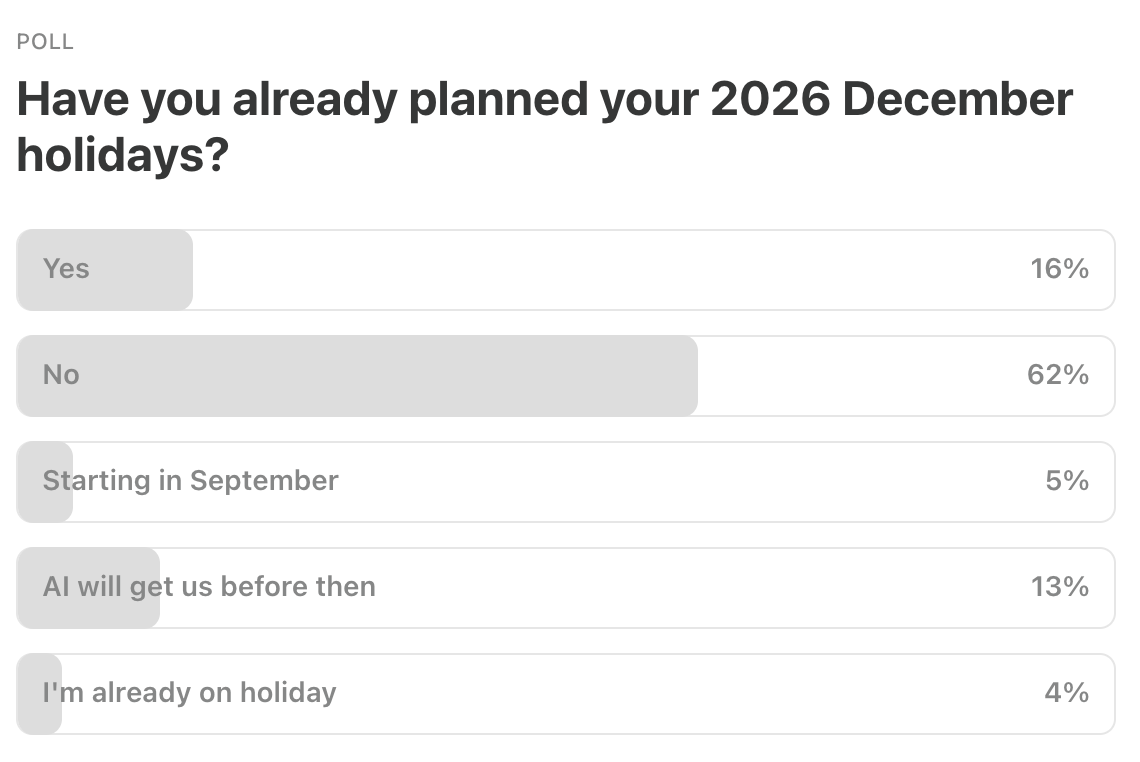
Last Week’s Poll:
.
Data Science Articles & Videos
Retire the Abstractions - We think CUDA DSLs are heading toward retirement
Last year, we set out to write megakernels. But implementing megakernels can be quite miserable. It requires complex data structures, extensive inter-thread/SM/GPU synchronization, deeply nested control flow, etc. We couldn’t hold it in our heads, so we did what computer science has done for 70 years: we built a layer of abstraction. Even with it, we had to fight through race conditions and deadlocks for a couple months before the Llamas ran blazingly fast. This year, we built an MoE megakernel, but we deleted the abstraction. With agents, we could work through the complexity directly and build target-optimized code from scratch. No intermediate layers of C++ abstraction were needed. So what could this mean?…Power 2026 - Electricity Pricing in the Age of AI
I’m a former quant researcher at a major hedge fund who covered power and gas, and I’ve spent much of the last couple of years advising founders and investors on data center buildouts (procuring GPUs, negotiating with coal plants, identifying sites)…This primer on power and data centers is for a broader audience who senses there’s an opportunity in energy markets and wants to get up to speed…By the end of this primer, you’ll understand:
Part 1: how power plants work, how data centers are developed, and how companies might respond (for founders/investors).
Part 2: how to price the US power markets (for traders).
If you’re really interested in power, I’d advise you to read the whole thing….
Dice, (De)Convolution and Generating Functions
I stumbled across a very cool YouTube video today that talks about how to look for alternate ways of labeling sides of two dice to give you the same random number distribution as if you added two standard dice together…Making customized dice give desired probability distributions is an interesting topic (like for game design!), but the math that was used in the video was also pretty neat. I’ll walk you through what they did and then we can talk about why it works, from two different points of view….Inside vLLM: Anatomy of a High-Throughput LLM Inference System
From paged attention, continuous batching, prefix caching, specdec, etc. to multi-GPU, multi-node dynamic serving at scale…In this post, I’ll gradually introduce all of the core system components and advanced features that make up a modern high-throughput LLM inference system. In particular, I’ll be doing a breakdown of how vLLM works….This post is the first in a series. It starts broad and then layers in detail (following an inverse-pyramid approach) so you can form an accurate high-level mental model of the complete system without drowning in minutiae…SQLite vs DuckDB on the same $16 box: every cliff moved 100x
Same $16.49/month server, same Traceway binary, two embedded databases. DuckDB writes 4x to 15x faster than SQLite, serves dashboards at 100x the row count, and stores a billion metric points in 10.8 GB. Full numbers and methodology inside…
Graphs Meet AI Agents: Taxonomy, Progress, and Future Opportunities
Graphs, with their natural advantage in organizing, managing, and harnessing intricate data relationships, present a powerful data paradigm for structurization to support the capabilities demanded by advanced AI agents. To this end, this survey presents a first systematic review of how graphs can empower AI agents. Specifically, we explore the integration of graph techniques with core agent functionalities, highlight notable applications, and identify prospective avenues for future research. By comprehensively surveying this burgeoning intersection, we hope to inspire the development of next-generation AI agents equipped to tackle increasingly sophisticated challenges with graphs…The Emerging Market for Intelligence: How Firms Buy and Sell AI
We describe the emerging business-to-business market for large language model (LLM) inference and document key empirical patterns in its supply, pricing, and dynamics, using data from OpenRouter. First, supply has expanded rapidly: the number of commercially available models, model creators, and inference providers has grown sharply, driven heavily by open-source entrants. Second, the price of intelligence has fallen roughly a thousandfold, and open-source models now cost about 90 percent less than comparable closed-source ones. Third, the market is highly dynamic, with frequent turnover among leading models and creators. Fourth, we document substantial horizontal and vertical differentiation: no single model dominates across use cases, and demand for intelligence varies widely across applications. We place these patterns in historical perspective alongside earlier general-purpose technologies…How Kimi K3 Engineered Its Way to the Frontier
Kimi K3 is an open-weight model with 2.78T total parameters, 104B activated per token, and a 1M-token training context…The 47-page technical report spans architecture, data, training, serving, and evaluation…This post covers three parts of it. The first is an attention design that reduces the cost of 1M-token contexts. The second is the kernel and parallelism work that makes that design fast enough to train at 3T scale. The third is agentic RL inside 51 million microVM sandboxes, paid for by the compute the first two saved. The code for all three is public…The acceptance-complement method revisited
We revisit the acceptance-complement method in random variate generation and show how it can replace the rejection method in many examples. While the rejection method has geometrically distributed execution times, the acceptance-complement method has a constant (deterministic) run time and qualifies as a ``one-liner’‘. We show how this method can be used to efficiently generate random variates from several distributions, such as the gamma and beta. In addition, we show that there is an acceptance-complement method that is valid for all log-concave densities with known location of the mode and black-box type access to the density…
Mapping runkeeper data
One of my constant irritations, as someone who loves to run and loves to analyze data, is that despite the many wonderful apps and gadgets we have for taking detailed measurements of our exercise patterns, the analyses that get shown to us as end-users of this tech are… well, at best they are boring. We get shown some graphs counting the number of steps we’ve taken, or a map showing where we ran on a specific day, and that’s about as good as it gets. Sadly, these anodyne data visualisations are often mixed with analyses that make absolutely no statistical sense, and a whole lot of junk that is best characterised as noise. Fortunately, it’s usually possible to export your data from these platforms and then do whatever analyses you want. To that end, I decided the time has come to download my runkeeper data and use it to draw some maps I actually want to see, and to answer some questions that have been nagging at me lately…A Visual Guide to Quantization: Demystifying the Compression of LLMs
In this post, I will introduce the field of quantization in the context of language modeling and explore concepts one by one to develop an intuition about the field. We will explore various methodologies, use cases, and the principles behind quantization. In this visual guide, there are more than 50 custom visuals to help you develop an intuition about quantization!…
How do you deal with AI Slop PRs from team members? [Reddit]
I understand that AI-assisted development is now part of our workflow, but I still think PR authors should be able to understand and explain the changes they made, what was done, why, and how…This week I challenged a team member on why something had been done a certain way, and their answer was “I don’t know, probably because Claude said so.” I was honestly a bit shocked. It gave me the feeling it’s just blindly trusted without any critical thinking on the person’s side. This is one of our more technical analysts, which is why they make code changes fairly often. I plan to bring it up in our weekly 1-1, but I wanted to check whether you are seeing the same thing on your side…Using Sorting In Database Systems
In this presentation I talk about using sorting in database systems (as opposed to sorting the data). This is my recording of a talk I gave at a database query and stream processing seminar…
Last Week's Newsletter's 3 Most Clicked Links
.
* Based on unique clicks.
** You can find last week's issue #662 here.
Cutting Room Floor
Why You Should Almost Never Use AI to Write Anything Substantive
Explorative Modeling: Unlocking a Third Pretraining Axis and End-to-End Generation
.
Thank you for joining us this week! :)
Stay Data Science-y!
All our best,
Hannah & Sebastian